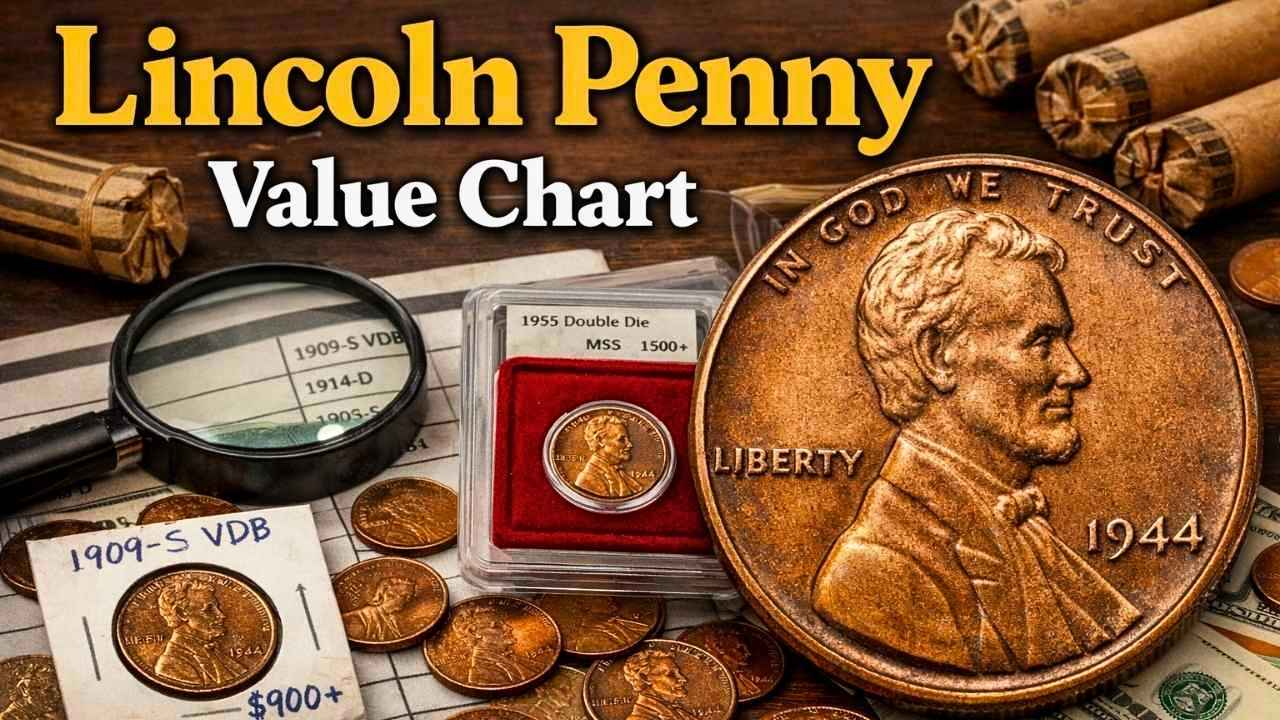
The Lincoln Penny has been a staple of American coinage since 1909, when it was first introduced to honor President Abraham Lincoln’s centennial. Over the years, this coin has become one of the most collected series in U.S. history, with countless varieties, mint marks, and errors that make certain issues highly valuable. In 2026, collectors continue to study Lincoln Pennies closely, tracking value trends and searching for rare treasures hidden in collections and circulation.
History of the Lincoln Penny
The Lincoln Penny was designed by Victor David Brenner and released in 1909. It was the first U.S. coin to feature a real person rather than a symbolic figure. The reverse originally displayed two wheat stalks, giving rise to the “Wheat Penny.” In 1959, the reverse was changed to the Lincoln Memorial, and in 2010, it was updated again to depict the Union Shield. Over time, the composition shifted from bronze and copper to copper‑plated zinc, reflecting changes in U.S. coinage materials.
Design Features
- Obverse: Portrait of Abraham Lincoln.
- Reverse: Wheat stalks (1909–1958), Lincoln Memorial (1959–2008), Union Shield (2010–present).
- Mint Marks: P (Philadelphia), D (Denver), S (San Francisco).
- Composition: Copper until 1982, copper‑plated zinc afterward.
Why Lincoln Pennies Can Be Valuable
Most Lincoln Pennies are common, but certain factors make some worth far more than face value:
- Rare minting errors such as double dies or missing mint marks.
- Low‑mintage issues from specific years.
- Proof coins struck for collectors.
- Exceptional condition certified by professional grading services.
- Historical significance tied to transitional designs and composition changes.
Rare Varieties and Mint Marks
1909-S VDB Lincoln Penny
The first year of issue included coins with the designer’s initials “VDB” on the reverse. The San Francisco Mint produced only 484,000 of these, making them one of the most famous rarities.
1914-D Lincoln Penny
The Denver Mint produced only 1.2 million pennies in 1914. High‑grade examples are scarce and can sell for tens of thousands.
1922 No D Lincoln Penny
Due to a minting error, some 1922 pennies struck in Denver lack the “D” mint mark. These are highly prized by collectors.
1955 Double Die Lincoln Penny
This error shows dramatic doubling in the date and lettering. It is one of the most popular error coins among collectors.
1969-S Double Die Lincoln Penny
A rare variety showing doubling in the obverse details. High‑grade examples are extremely valuable.
1972 Double Die Lincoln Penny
Another famous error, with noticeable doubling in the date and inscriptions.
1982 Small Date Copper Lincoln Penny
During the transition from copper to zinc, some small date copper pennies were struck, making them rare.
1992 Close AM Lincoln Penny
This variety shows the letters “A” and “M” in “AMERICA” unusually close together. It is rare and valuable.
1995 Double Die Lincoln Penny
A modern error with doubling in the obverse lettering, popular among collectors.
Value Chart
| Coin | Description | Approximate Value Range |
|---|---|---|
| 1909-S VDB | First year issue, rare | $700 – $15,000+ |
| 1914-D | Low mintage Denver issue | $300 – $20,000+ |
| 1922 No D | Minting error | $500 – $25,000+ |
| 1955 Double Die | Dramatic doubling | $1,000 – $25,000+ |
| 1969-S Double Die | Rare variety | $10,000 – $100,000+ |
| 1972 Double Die | Doubling in design | $100 – $500+ |
| 1982 Small Date Copper | Transitional rarity | $50 – $1,000+ |
| 1992 Close AM | Rare variety | $500 – $5,000+ |
| 1995 Double Die | Modern error | $20 – $200+ |
Collecting Tips
- Always check mint marks carefully, as they can dramatically affect value.
- Proof and error coins are more valuable than circulation strikes.
- Use magnification to spot doubling or unusual features.
- Store coins in protective holders to preserve condition.
- Consider professional grading to authenticate rare varieties.
Key Highlights
- The Lincoln Penny was introduced in 1909 and remains a popular collectible.
- Rare varieties include the 1909-S VDB, 1914-D, 1922 No D, and 1955 Double Die.
- Errors such as double dies and transitional issues can make coins worth thousands.
- Condition, rarity, and mint marks are the most important factors in determining value.
- Collectors in 2026 continue to track value trends and hunt for hidden treasures.
Final Words
The Lincoln Penny is more than just a coin; it is a tribute to President Abraham Lincoln and a symbol of American history. While most examples are worth only face value, rare varieties and high‑grade coins can be worth thousands, even hundreds of thousands. For collectors, the thrill of discovering one of these treasures is unmatched. Whether you are just beginning your coin collecting journey or are an experienced numismatist, Lincoln Pennies offer both historical significance and the excitement of hidden treasures that continue to inspire admiration in 2026 and beyond.